
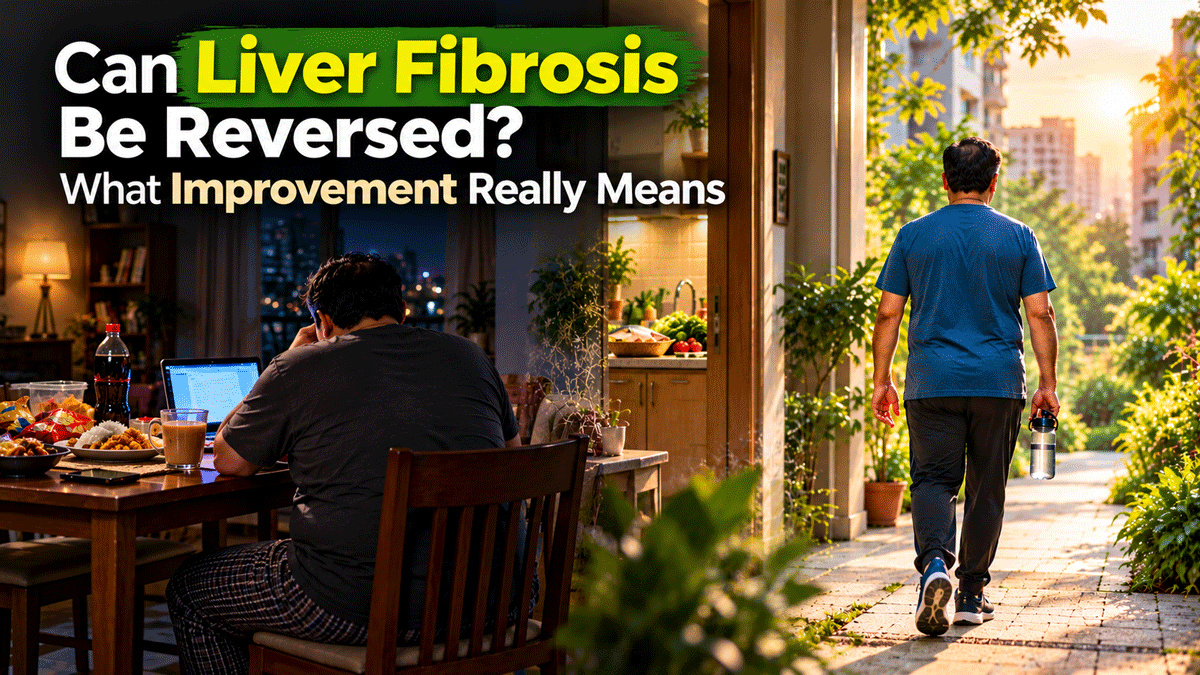
Can liver fibrosis be reversed? Some scarring can regress when the underlying injury is effectively treated, but improvement depends on the disease, its severity and the response to care.
Your liver report mentions fibrosis, and the search results seem to disagree. One promises complete reversal through a special diet; another makes the diagnosis sound like the end of every possibility.
The word “reversal” needs a more precise explanation than a before-and-after testimonial provides.
For Health Revolution readers, the JK Lifestyle approach places daily habits alongside proper liver assessment. The useful starting point is understanding what is injured, what treatment addresses it and which evidence would show a meaningful change.
A clearer explanation also protects you from two mistakes: giving up on treatment because damage sounds permanent, or abandoning follow-up because one result looks better. Hope becomes more useful when it has an accurate definition.
Can Liver Fibrosis Be Reversed Naturally?
Yes, early-to-moderate liver fibrosis (stages F1 to F3) can be reversed when the underlying metabolic cause—most commonly insulin resistance, visceral fat accumulation, and toxic dietary oils—is systematically resolved. Removing the ongoing liver insult deactivates hepatic stellate cells, allowing specialized liver macrophages (Kupffer cells) to resorb and break down scar collagen.
- Reversibility of Early Stages: Fibrosis stages F1, F2, and early F3 have documented clinical regression once hepatic steatosis is eliminated.
- Stellate Cell Deactivation: Halting lipid accumulation and oxidative stress reverts collagen-producing stellate cells to an inactive state.
- Hepatic Autophagy: Intermittent fasting triggers cellular digestion of damaged proteins and intracellular lipid droplets inside hepatocytes.

1. How does fibrosis differ from liver fat and cirrhosis?
Fat accumulation, inflammation and scarring are different findings. A report describing a fatty liver does not, by those words alone, tell you the extent of fibrosis or establish that you have cirrhosis.
With cirrhosis, extensive scarring disrupts the liver’s structure and can interfere with both its function and blood flow. NIDDK’s explanation of cirrhosis describes how resistance to that blood flow can cause portal hypertension and complications.
This distinction explains why a liver team does more than look for fat on a scan. The questions include whether important structural damage or complications are present, not merely whether a picture looks brighter than expected.
Our fatty liver symptoms guide gives background, but symptoms cannot substitute for the report’s actual findings. Some people with cirrhosis have few obvious symptoms until substantial damage has occurred.
Read “fibrosis suspected” differently from “cirrhosis diagnosed.” Those phrases carry different levels of certainty and should not be turned into the same personal prognosis by an online calculator or a marketing claim.
2. Can the liver heal from fibrosis through tissue repair?
Scar tissue can undergo biological remodelling. Fibrosis involves the accumulation of a supporting material called extracellular matrix, including collagen. Activated liver cells called stellate cells help produce that material during injury; the balance between deposition and breakdown influences the scar.
In Iredale and colleagues’ experimental study of fibrosis resolution, rat livers were examined after the injuring chemical was withdrawn. Regression was associated with fewer activated stellate cells, changes in inhibitors of matrix breakdown and increased collagen-degrading activity.
This was an animal experiment, not a trial showing that a food, supplement or fasting routine removes human liver scars. Its value is mechanistic: it demonstrates why fibrosis is not simply inert material that can never change.
It also explains why the phrase “the liver regenerates” is too broad to settle an individual case. A biological capacity for repair does not tell us how much recovery will occur in a particular disease or stage.
Keep the distinction between possibility and prediction. A convincing explanation of a pathway should lead to properly tested treatment, not an unsupported promise that activating that pathway guarantees a cure.
3. What does human evidence show about liver fibrosis reversal?
A five-year study of tenofovir treatment for chronic hepatitis B provides evidence from human liver biopsies. Of the 348 participants with samples available at both time points, 176 had an improvement in fibrosis score.
Some people who had cirrhosis at the beginning also improved histologically. These findings occurred during sustained antiviral treatment, so they cannot be used to argue that medication was unnecessary or that diet alone produced the result.
The denominator matters: 348 people with paired samples were a subset of the original 641 participants. Reporting the response as though every original participant had a repeat biopsy would make the finding appear more complete than it was.
The treatment, disease and measurement all matter when applying the study. It establishes that regression can happen in treated hepatitis B; it does not supply a universal success rate for all causes of liver fibrosis.
When you encounter a claim about “reversing liver scarring,” look for those three details. Without them, the percentage may sound reassuring while answering a different question from the one you actually have.
4. What does lifestyle research show about reversing liver scarring?
In a 52-week prospective study of people with biopsy-proven inflammatory fatty liver disease, 293 participants were encouraged to make lifestyle changes. Paired biopsies were available for 261, and greater weight loss was associated with greater improvement in several liver findings.
Fibrosis regression was recorded in 56 participants, reported as 19% of the enrolled group. Among those who lost at least 10% of body weight, 45% had fibrosis regression; this subgroup result does not mean every person reaching that weight change will have the same outcome.
The study was prospective rather than a randomised comparison of different weight-loss targets. Its association supports appropriate lifestyle care, while leaving uncertainty about an individual’s response and the contributions of different changes.
It also does not prescribe rapid weight loss, prolonged fasting or a fixed target for someone with advanced cirrhosis. The participant group and clinical setting must remain attached to the result.
Use this evidence to ask for a suitable plan, not to create a pass-or-fail deadline. A study endpoint is a way of measuring a group response; it is not a promise that your liver must meet.
5. Which medical options depend on the cause and stage?
In March 2024, the US FDA approved resmetirom for specified adults with noncirrhotic NASH and moderate-to-advanced fibrosis. It was approved for use with diet and exercise, rather than as a replacement for those measures.
The accelerated approval relied on biopsy-based surrogate outcomes, including improvement in scarring, while further clinical-benefit assessment was required. A surrogate result is an indicator expected to relate to benefit; it is not identical to directly showing every long-term complication has been prevented.
This is a dated United States regulatory example, not a complete list of current treatments or a statement about availability in Bangladesh. It does not establish that the medicine is suitable for cirrhosis or for every cause of fibrosis.
The useful lesson is that “there are no medical options” is too sweeping. Equally, the existence of a medicine does not remove the need to establish the correct diagnosis and treatment eligibility.
Evaluate a proposed option by the condition it treats and the outcome it has demonstrated. A product advertised vaguely for “liver repair” has not answered either question.
6. Which tests can help assess progress?
Assessment can combine medical history, examination, blood tests and imaging. NIDDK’s diagnostic guidance explains that elastography measures stiffness, while a biopsy allows a pathologist to examine a small tissue sample directly.
Blood tests can help identify causes and assess severity; imaging can assess liver appearance and other features. A biopsy may help when other findings are uncertain, but it is not automatically required for every person or every follow-up visit.
| Assessment | What it contributes |
|---|---|
| Blood tests | Clues about cause, injury and severity |
| Elastography | A measurement of liver stiffness |
| Liver biopsy | Microscopic assessment of sampled tissue |
This is why two hypothetical reports reading “enzymes improved” and “fibrosis score improved” should not be treated as interchangeable. They refer to different measurements, even when both developments are welcome.
Keep the name of the test attached to the claim. Saying “my liver is better” may be a reasonable personal description, but it is not precise enough to decide which follow-up is still needed.
The next comparison should use the clinical meaning of the result, rather than a contest over which report contains the most reassuring phrase.
7. Does a lower stiffness reading prove scars disappeared?
No. Stiffness can change for reasons besides the amount of scar tissue. In a 78-week prospective study of treated hepatitis B, decreases in liver stiffness could reflect improvement in inflammation, rather than serving as proof of fibrosis regression by themselves.
This does not make elastography useless. It means the measurement needs interpretation in the context of treatment, the disease and other findings, rather than being read as a direct percentage of scar removed.
Consider a clearly hypothetical example: a stiffness reading falls after treatment starts. That is a result worth discussing, but “the number fell by half” does not justify concluding that exactly half the scar tissue has vanished.
The units describe a physical measurement; they are not a count of scar cells. Translating a change into a precise amount of healing adds a claim the test has not established.
The same caution applies to dramatic online before-and-after images. Without the test method, timing and interpretation, you cannot know whether the comparison demonstrates reduced inflammation, less fat, scar regression or something else.
8. How should daily habits fit the liver treatment plan?
NIDDK’s cirrhosis treatment guidance describes cause-specific care, including antivirals for viral hepatitis and medicines for autoimmune disease. Alcohol cessation and suitable nutrition or weight management may be relevant, depending on the diagnosis.
With cirrhosis, avoid alcohol and review supplements, herbal products and non-prescription medicines with your liver team. A “natural” label does not answer whether a product is appropriate for someone with liver disease.
Do not stop prescribed treatment or start an aggressive weight-loss routine because another person’s scan improved. Daily changes need to fit the medical plan and any complications already present.
Vomiting blood or passing black or bloody stools requires immediate hospital care. New confusion needs urgent medical assessment. These are not situations to manage by adjusting a meal plan or waiting for a routine consultation.
For ordinary implementation, make the instructions usable at home: which meals need changing, who prepares them and what the agreed activity looks like. Specific arrangements help distinguish a treatment plan from a collection of encouraging slogans.
9. Why can surveillance remain necessary after improvement?
Treating the original cause and eliminating future risk are different outcomes. The AASLD–IDSA hepatitis C guidance provides a clear example: people with cirrhosis remain at risk of liver cancer even after successful antiviral treatment.
For that group, the guidance recommends surveillance every six months using ultrasound, with or without alpha-fetoprotein testing. Viral cure is therefore a major success that does not automatically cancel the cirrhosis follow-up plan.
This distinction prevents a common misunderstanding. “The infection is cured” and “there is no remaining liver risk” are different statements, and only the first may have been established by the treatment result.
Your own monitoring depends on the diagnosis and specialist assessment. The hepatitis C example illustrates the principle; it is not an instruction to apply one schedule to everyone with a fatty liver report.
Assess liver fibrosis reversal within a wider care plan: controlling the disease, reducing injury and maintaining appropriate surveillance can all matter. A sensible plan should tell you which outcome has improved and which responsibility remains, without making those messages sound contradictory.
The JK Lifestyle Hepatic Regeneration Framework
The human liver possesses an extraordinary capacity to regenerate itself when given the proper biological environment. At Health Revolution, our specialized consultations focus on halting liver injury before irreversible cirrhosis occurs.
Our foundational liver recovery plan combines three core elements:
- Deep Intermittent Fasting: Fasting windows of 16 to 20 hours drain liver glycogen, forcing hepatocytes to burn stored fat droplets and activating hepatic autophagy to clear accumulated scar proteins.
- Anti-Inflammatory Nutrition: Cooking exclusively with clean, unoxidized fats—such as Ultimate Organic Life Grass-Fed Ghee and Cold-Pressed Extra Virgin Olive Oil—provides nourishing fat-soluble vitamins without creating toxic lipid peroxides in the liver.
- Daily Morning Tonic: A glass of lukewarm water infused with 1 tablespoon of Ultimate Organic Life Raw Apple Cider Vinegar (with the Mother) and lemon juice aids liver bile flow, optimizes stomach acidity, and supports natural phase II detoxification.
The Molecular Biology of Liver Fibrogenesis and Resolution
Liver fibrosis is not a passive, permanent scar; it is a highly dynamic wound-healing response governed by hepatic cellular crosstalk. Understanding the cellular players reveals why stages F1, F2, and early F3 fibrosis are clinically reversible:
- The Culprit: Hepatic Stellate Cells (HSCs): In a healthy liver, HSCs reside in the space of Disse in a quiescent state, storing vitamin A. When chronic oxidative stress, lipid peroxidation (from toxic seed oils), and hyperinsulinemia cause persistent hepatocyte ballooning and death, inflammatory signals (TGF-beta1 and PDGF) activate HSCs. Once activated, they transdifferentiate into proliferative, contractile myofibroblasts that rapidly synthesize dense Type I and Type III collagen fibrils.
- The Mechanism of Reversal: When the underlying injury is eradicated—by halting lipotoxicity and insulin resistance—activated myofibroblasts either undergo programmed apoptosis (cell death) or revert to a quiescent phenotype. Concurrently, liver-resident macrophages (Kupffer cells) switch from a pro-inflammatory M1 state to a restorative M2 phenotype, upregulating matrix metalloproteinases (MMPs, especially MMP-2, MMP-9, and MMP-13) that enzymatically digest and dissolve the extracellular collagen scar.
Non-Invasive Diagnostic Formulas Every Patient Can Calculate
| Clinical Assessment Score | Mathematical Formula | Low-Risk Cutoff (< F2 Fibrosis) | High-Risk Cutoff (≥ F3 Fibrosis) |
|---|---|---|---|
| FIB-4 Index | (Age [yrs] × AST [U/L]) / (Platelets [10^9/L] × √ALT [U/L]) | Score < 1.30 (90% negative predictive value) | Score > 2.67 (advanced fibrosis confirmed) |
| AST-to-Platelet Ratio (APRI) | ((AST / AST Upper Normal) / Platelets) × 100 | Score < 0.50 | Score > 1.50 |
| NAFLD Fibrosis Score (NFS) | Composite score using Age, BMI, IFG/Diabetes, AST/ALT, Platelets, Albumin | Score < -1.455 | Score > 0.676 |
Clinical Hepatic Regeneration Protocol
To stimulate maximum macrophage matrix metalloproteinase activity and reverse early fibrosis:
- Deep Autophagic Fasting: Implement 18 to 20 hours of daily fasting. Fasting stimulates cellular autophagy through AMPK activation and mTOR deactivation, enabling hepatocytes to clear misfolded proteins and intracellular fat vacuoles.
- Anti-Inflammatory Lipids: Replace toxic, chemically bleached seed oils with Ultimate Organic Life Grass-Fed Ghee and Cold-Pressed Extra Virgin Olive Oil. Pure ghee contains butyrate and conjugated linoleic acid (CLA), which suppress hepatic NF-kB inflammatory cascades.
- Hydration & Electrolyte Support: Drink 2 to 3 liters of water daily seasoned with Ultimate Organic Life Himalayan Pink Salt and fresh lemon juice to maintain cellular hydration, support kidney clearance, and optimize bile flow.
Frequently Asked Questions
Can liver fibrosis be reversed without medicine?
It depends on the underlying disease. Regression during antiviral treatment cannot be used as evidence that prescribed medication is unnecessary.
Is fibrosis the same as cirrhosis?
Fibrosis means scarring; cirrhosis involves advanced structural damage. The distinction affects assessment, complications and follow-up.
How long does liver fibrosis reversal take?
There is no universal timetable. The duration of a particular study does not predict when, or whether, an individual will improve.
Does a normal ALT result mean fibrosis has gone?
No. Liver-enzyme results and assessment of scar tissue answer different questions and need to be interpreted together.
Can the liver heal from fibrosis with a detox?
Do not rely on that claim. Keep cause-specific treatment in place and review supplements with the team managing your liver disease.
The Bottom Line
Liver fibrosis can regress in some circumstances, but credible hope depends on an accurate diagnosis and evidence-based follow-up. A Health Revolution consultation can help connect daily habits with that plan while specialist liver care remains in place.
Book Your Lifestyle Consultation — Call 09678-242404.