
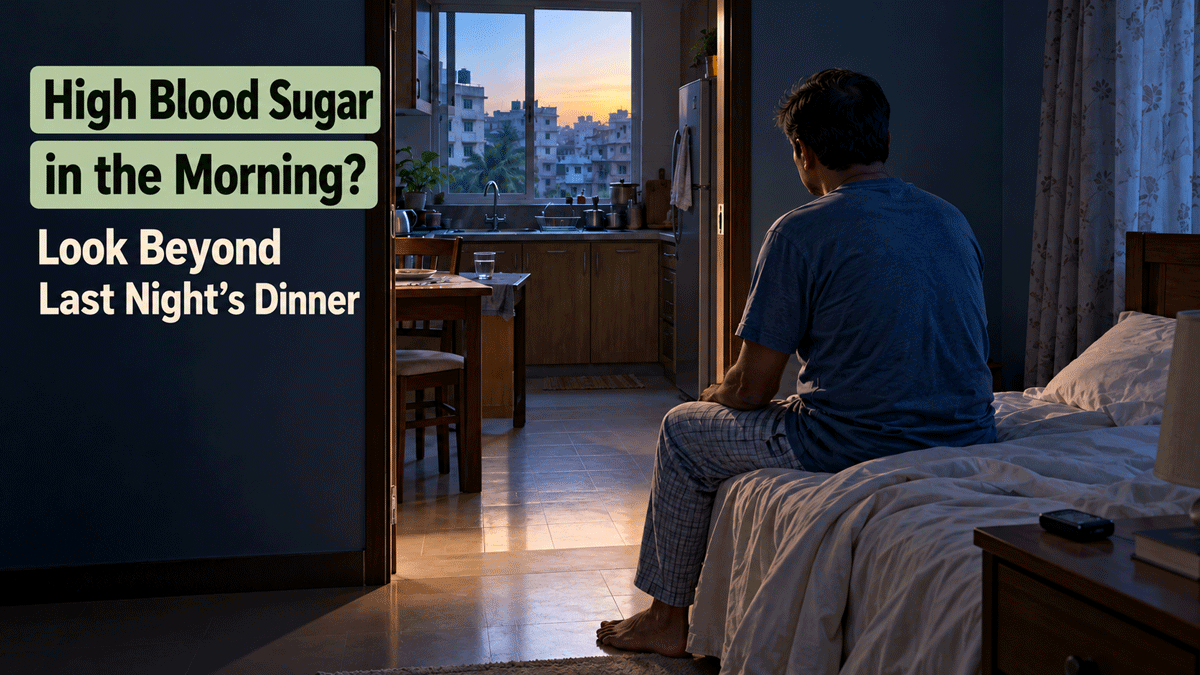
High blood sugar in the morning can reflect an early-morning hormone rise, glucose that stayed high after dinner or insufficient overnight insulin coverage. One waking result cannot identify the cause; the overnight pattern, measurement quality and your treatment context matter.
You have not eaten since dinner, yet your morning glucose is higher than expected. Before you blame your discipline, look at what happened overnight.
Why Is Fasting Blood Sugar High in the Morning (The Dawn Phenomenon)?
Elevated morning blood sugar is typically caused by the Dawn Phenomenon—a natural surge of counter-regulatory hormones (cortisol, growth hormone, and glucagon) between 4:00 AM and 8:00 AM that signals the liver to release stored glucose to awaken the body. In individuals with hepatic insulin resistance, the liver overproduces glucose, leading to an unexpected high morning reading even after an overnight fast.
- The Hepatic Dawn Surge: The liver pumps glucose into circulation to provide awakening energy, irrespective of what was eaten the night before.
- Physiological Insulin Resistance: On long-term low-carb or keto diets, mild morning glucose elevation can represent normal “adaptive glucose sparing” to reserve fuel for red blood cells.
- Evening Habit Control: Ending dinner before sunset and eliminating late-night snacks minimizes nighttime liver glycogen replenishment.

1. Why can glucose rise while you sleep?
Not eating does not mean glucose disappears from the bloodstream. Your body continues supplying energy overnight, and hormones involved in preparing you to wake can work against insulin’s glucose-lowering effects.
The dawn phenomenon is an early-morning rise in glucose in people with diabetes. Cleveland Clinic explains the hormonal contribution, including how cortisol and growth hormone signal the liver to increase its glucose supply.
When insulin supply is insufficient or insulin resistance reduces its action, glucose may climb before breakfast. This is why an empty stomach and a higher reading can occur together without an overnight snack being the explanation.
The timing of a rise matters, but timing alone does not establish its cause. A morning result is the final point of a longer sequence, not a recording of everything that happened during the night.
Imagine seeing the final page of a story with all the earlier pages missing. You know where the story ended, but cannot confidently identify which event produced that ending; glucose interpretation has the same limitation when only one reading is available.
2. Which overnight patterns explain high blood sugar in the morning?
The American Diabetes Association’s morning-glucose guidance distinguishes dawn-related increases from insulin coverage that becomes insufficient overnight. A level that is already high at bedtime can also remain elevated into the morning.
Your team may use selected bedtime and overnight checks, or a continuous glucose monitor, to see which pattern is present. Do not assume you need to wake repeatedly every night; the checks should answer a defined question.
| Observed pattern | What it helps the clinician examine |
|---|---|
| High at bedtime and still high on waking | Evening food, treatment and persistent elevation |
| Lower earlier, then rising toward morning | Timing of the rise and overnight insulin coverage |
| A documented low during the night | Hypoglycemia safety before any treatment increase |
Consider two hypothetical records that both end at 160 mg/dL. One begins at 190 mg/dL at bedtime; the other begins at 110 mg/dL and rises later.
These examples are not treatment targets or diagnostic exercises. They show why the identical final number can lead to different questions, and why increasing medicine from the waking value alone can be a poor decision.
3. How can you check an unexpected meter result?
Before interpreting an unexpected result, check how it was obtained. Food residue on a fingertip, an unsuitable strip or an inadequate blood sample can affect a meter reading.
The FDA’s glucose-meter instructions recommend washing your hands, using the correct unexpired strips and following the device’s testing procedure. If you have doubts about the sample or procedure, repeat the test correctly.
Treat a repeat as a quality check, not a contest to obtain the number you prefer. If a result remains high, retain both values and explain why the second measurement was taken.
A practical hypothetical example is checking glucose immediately after handling fruit. Washing and drying your hands before a new test addresses possible contamination; it does not prove that any remaining elevation is harmless.
Record the units as well as the number. “Seven” and “126” can describe approximately the same glucose concentration when one device uses mmol/L and the other uses mg/dL, so a copied number without units can create unnecessary confusion.
If symptoms are concerning, seek care rather than repeatedly troubleshooting the device. A meter check should never delay help for someone who is vomiting, confused or having difficulty breathing.
4. How does prediabetes testing differ from daily monitoring?
A home meter is useful for monitoring, but an isolated home result does not establish diabetes. Diagnostic testing uses appropriate laboratory methods and clinical interpretation, with repeat testing often needed to confirm an abnormal finding.
The CDC’s diabetes testing guidance lists fasting glucose of 100–125 mg/dL in the prediabetes range and 126 mg/dL or above in the diabetes range. In mmol/L, these correspond to 5.6–6.9 and 7.0 or above; these are nonpregnant-adult diagnostic categories, not personalised treatment goals.
HbA1c answers a different question from the waking finger-prick. It reflects average glucose over roughly two to three months, so it cannot show exactly when a particular night’s rise occurred.
The MedlinePlus A1c explanation distinguishes this longer view from a current glucose measurement. Anaemia, some blood disorders, kidney failure and other circumstances can affect interpretation.
Here is a purely mathematical illustration: two numbers, 80 and 180, average 130; two readings of 130 also average 130. The averages match, but the variation is different, which explains why an overall average and a glucose pattern provide complementary information.
That example is not an A1c calculation. It simply shows why an acceptable average should not make repeated lows invisible, and why one higher morning reading cannot describe several months of glucose exposure.
5. Why should overnight lows come before a lower morning number?
Low glucose can occur during sleep, particularly when insulin, food intake and activity do not match. You cannot rely on waking up whenever it happens.
The CDC’s hypoglycemia guidance identifies glucose below 70 mg/dL, or approximately 3.9 mmol/L, as low. Overnight activity effects, too much insulin and alcohol can contribute; a CGM may help detect episodes when appropriate.
A morning high does not prove there was a preceding low. Equally, the presence of a morning high does not make a documented overnight low unimportant.
The practical priority is to follow your existing hypoglycemia instructions and discuss recurrent lows promptly. Do not independently add insulin, skip meals or extend a fast simply to improve the waking figure.
For example, if an agreed monitoring plan captures a low overnight and a high on waking, those are two findings to explain together. Treating only the second number ignores the more immediate safety issue already demonstrated by the first.
Meal timing and medicine timing should therefore be considered as a pair. A plan that looks attractive on paper may be unsuitable if it removes food that your current treatment was designed around.
6. What should you change about dinner?
Review carbohydrate portions, the food form and what accompanies them at dinner; each influences how useful a proposed change may be. A sugary drink and whole fruit are not nutritionally interchangeable simply because both contain carbohydrate.
The CDC’s meal-planning guidance uses nonstarchy vegetables, protein foods and an appropriate portion of carbohydrate to structure a meal. Protein, fat and fibre can slow the speed of a glucose rise, although adding them does not cancel the carbohydrate in a large portion.
For a practical hypothetical dinner review, compare a plate containing mostly rice plus a sweet drink with a plate that also includes vegetables and fish, alongside water. The purpose is to identify specific differences worth adjusting within your plan, not to predict an exact glucose reduction.
Include food eaten after dinner in that comparison. Describing dinner carefully while overlooking sweetened tea and repeated snacks leaves part of the evening unexplained.
For readers undergoing prediabetes testing, the same food-quality principles can inform the discussion without replacing diagnosis. Our prediabetes food-chart article offers related meal ideas. Choose an adjustment you can describe precisely, such as the drink or carbohydrate portion, instead of declaring that tomorrow you will simply “eat perfectly.”
7. How can activity support your glucose pattern?
Regular physical activity helps manage glucose and contributes to cardiovascular health. The CDC’s diabetes activity guidance suggests starting gradually, such as with a manageable walk after dinner, rather than assuming benefits require hours in a gym.
That is different from suddenly attempting a hard workout because this morning’s number upset you. A repeatable activity pattern is easier to evaluate than an occasional burst of exercise chosen in frustration.
Think about the actual activity available to you: a safe walking route, indoor movement or exercises adapted to your mobility. The useful question is what you can perform consistently and safely alongside your treatment.
Keep the dose understandable. “A comfortable ten-minute walk after dinner” describes a task; “I exercised a lot” leaves the duration and effort unclear.
When comparing mornings, note a substantial change in activity rather than attributing every difference to dinner. This does not require analysing every step: it means recognising that a very active day and a mostly seated day are different contexts.
Insulin-related low-glucose precautions still apply. Discuss how to monitor around a new activity routine, especially when exercise is close to bedtime or you have had previous lows.
8. How can sleep and mental peace fit the plan?
Address the actual obstacle to restful sleep, while recognising that no bedtime routine guarantees an overnight glucose correction. The CDC’s diabetes sleep resource describes links with hormone regulation and the practical obstacles that can interfere with restful sleep.
Look for the obstacle that actually exists: a bright room, late screen use, noise or an evening routine that repeatedly leaves too little time in bed. Each suggests a different action, so a generic instruction to “sleep better” is rarely enough.
For example, someone whose bedtime slips because work messages continue late may need a boundary around notifications. Someone disturbed by light may need a change to the sleeping environment; these are practical examples, not guaranteed glucose treatments.
The JK approach also makes room for personally meaningful spiritual support. Namaz, Dhikr or Ruqyah can be part of an evening routine if they fit your beliefs, without being presented as substitutes for diabetes treatment.
Our sleep and health article explores the wider context. Persistent sleep problems deserve attention, but a single difficult night does not explain every high reading or establish a new diagnosis.
9. When does a morning high need urgent help?
Repeated morning highs need a treatment review; severe symptoms need a faster response. Diabetic ketoacidosis can develop when there is too little insulin and ketones accumulate to dangerous levels, including in some people with type 2 diabetes.
The CDC’s ketoacidosis guidance advises emergency care when glucose stays at 300 mg/dL, approximately 16.7 mmol/L, or above. High ketones, fruity-smelling breath, difficulty breathing or vomiting that prevents you keeping fluids down are also urgent warning signs.
Do not wait for a particular glucose number when those symptoms are present. Follow your sick-day and ketone-testing instructions if you have diabetes, and do not treat an acute illness as a reason to improvise medicine changes.
A food experiment, an extra walk or a routine lifestyle appointment is not the right response to a possible emergency. The distinction is simple: patterns can be reviewed thoughtfully when you are well, but severe symptoms change the priority immediately.
Frequently Asked Questions
Why is my blood sugar high before I eat anything?
Your body continues supplying glucose overnight. Hormonal changes and insufficient insulin action, including insulin resistance, can contribute, so the absence of food does not rule out an early-morning rise.
Does one high morning reading mean prediabetes?
No. An isolated home result cannot establish the diagnosis; recurrent high readings warrant appropriate laboratory testing and clinical interpretation.
Can an acceptable HbA1c hide morning highs?
Yes. An average does not show every rise or low, so your team may interpret HbA1c alongside targeted readings or CGM patterns.
Should I skip breakfast to bring the number down?
Do not skip meals simply to chase a reading. Meal timing needs to fit your medicines and hypoglycemia plan, particularly when insulin is involved.
Should I take extra insulin for a morning high?
Use your prescribed adjustment plan. Without understanding the overnight pattern, an extra dose or a change in background insulin could create dangerous lows.
Mastering the Dawn Phenomenon with JK Lifestyle
At Health Revolution, Dr. Jahangir Kabir frequently reassures patients who panic over a high morning glucose reading. In an insulin-resistant body, an engorged fatty liver easily releases glucose into the bloodstream in response to natural morning cortisol.
To systematically lower your morning readings:
- Eat Dinner Before Sunset: Finishing your last meal early allows the liver to clear circulating glucose and burn through stored glycogen hours before the 4:00 AM hormone surge begins.
- The Morning Detox Tonic: Upon waking, drink a tall glass of lukewarm water infused with 1 tablespoon of Ultimate Organic Life Raw Apple Cider Vinegar (with the Mother), fresh lemon juice, and a pinch of pink salt. Acetic acid in raw ACV enhances hepatic insulin sensitivity and blunts morning glucose output.
- Take a Brisk Morning Walk: A 30-minute fasted morning walk in the sunshine puts your leg muscles to work, soaking up circulating morning glucose without requiring extra insulin.
The Biochemical Mechanics of Morning Hyperglycemia: Dawn Phenomenon vs. Somogyi Effect
To accurately address high waking blood glucose, clinicians and patients must differentiate between two distinct physiological events that require opposite interventions:
- The True Dawn Phenomenon (Hepatic Gluconeogenesis): Between 3:30 AM and 6:00 AM, the brain’s suprachiasmatic nucleus triggers a pulsatile circadian release of cortisol, growth hormone, and adrenaline. In a metabolically healthy individual, pancreatic beta cells secrete a corresponding micro-pulse of insulin to keep blood sugar stable. In an insulin-resistant individual with a fatty liver, the liver’s insulin receptors fail to turn off glucose production, causing excessive glucose output into the bloodstream before awakening.
- The Somogyi Effect (Rebound Hyperglycemia): This occurs primarily in individuals on exogenous insulin or sulfonylureas. Blood sugar crashes dangerously low (hypoglycemia) between 2:00 AM and 3:00 AM. In panic, the adrenal glands release massive emergency adrenaline and cortisol surges, resulting in a dramatic rebound spike by 7:00 AM. Testing capillary glucose at 3:00 AM for three consecutive nights clarifies the diagnosis: if 3:00 AM glucose is elevated, it is the Dawn Phenomenon; if 3:00 AM glucose is below 70 mg/dL, it is the Somogyi Effect.
Actionable 4-Step Protocol to Blunt the Dawn Spike
| Step | Timing | Biological Action | Protocol Details |
|---|---|---|---|
| 1. Early Dinner Cutoff | Before 6:30 PM | Exhausts postprandial liver glycogen before sleep | Zero late-night snacking. Consume high-protein, fibrous vegetables cooked in Ultimate Organic Life Grass-Fed Ghee. |
| 2. Acetic Acid Evening Rinse | 30 mins before bed | Downregulates hepatic G6Pase enzyme | 1 tablespoon of Ultimate Organic Life Raw ACV (with the Mother) diluted in 150ml lukewarm water. |
| 3. Morning Hydration Tonic | Immediately upon waking | Clears hemoconcentration & replenishes electrolytes | 500ml water + 1/4 tsp Ultimate Organic Life Himalayan Pink Salt + juice of half a fresh lemon. |
| 4. Fasted Solar Movement | Within 60 mins of waking | Activates skeletal muscle GLUT4 glucose uptake | 30–45 minutes of brisk walking in natural morning sunlight; soak up morning lumens to reset circadian melatonin. |
The Bottom Line
High blood sugar in the morning is a reason to understand the sequence, not judge your willpower. Check measurement quality, separate overnight patterns and make food, activity and sleep changes that fit your treatment; a Health Revolution consultation can support that wider lifestyle work.
Book Your Lifestyle Consultation — Call 09678-242404.