
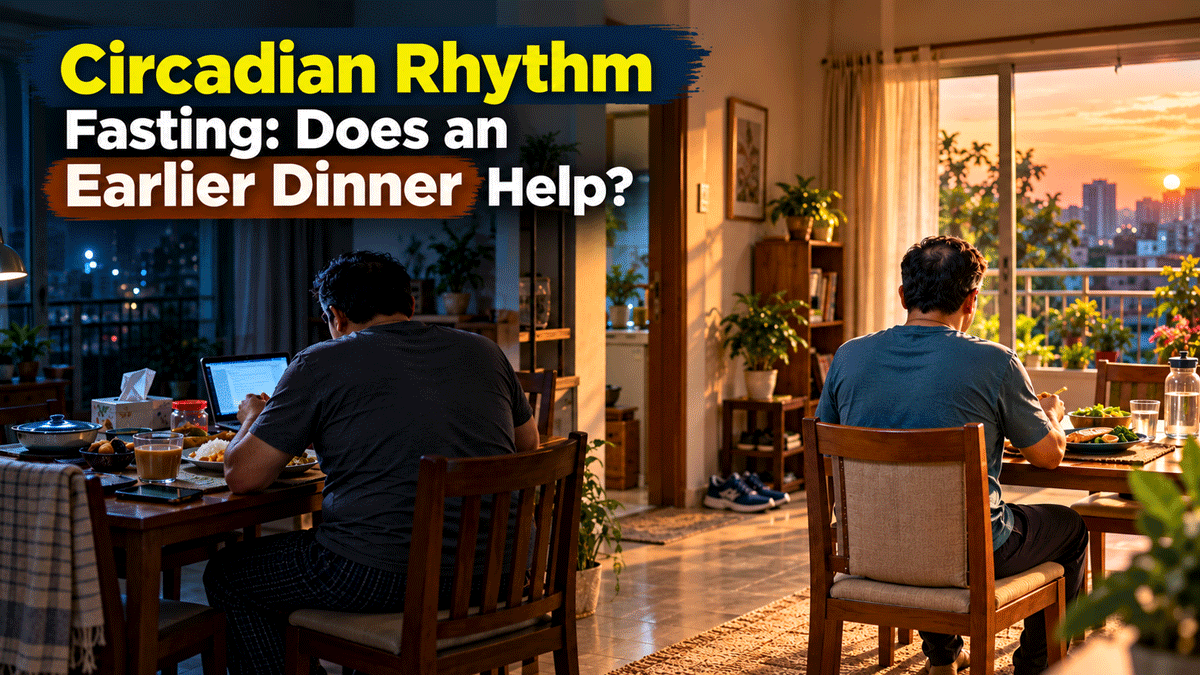
Circadian rhythm fasting means aligning a daily eating window with biological timing, often by eating earlier. Small controlled studies suggest benefits for insulin sensitivity, but larger trials do not establish one ideal window, guaranteed fat loss or a universal sunset deadline.
Dinner slips to 10 p.m., bedtime follows soon after, and the next morning begins with a promise to fix your eating window. Then a headline claims that finishing before sunset will dramatically improve insulin.
Does Early Circadian Fasting (Finishing Dinner Earlier) Improve Health?
Yes, clinical research confirms that early time-restricted feeding (eating between 8:00 AM and 5:00 PM) dramatically improves insulin sensitivity, lowers 24-hour blood pressure, and reduces oxidative stress compared to late-evening eating. The human pancreas is genetically programmed to produce insulin efficiently during daylight hours and downregulates metabolic processing as night falls.
- Melatonin vs. Insulin Conflict: When the sleep hormone melatonin rises after dark, it binds to pancreatic receptors and suppresses insulin secretion.
- Overnight Fat Burning: Ending meals before sunset gives the liver 4–6 hours to clear post-meal glucose before deep sleep begins.
- Enhanced Sleep Quality: Sleeping with an empty stomach deepens slow-wave rest, preventing midnight acid reflux and glucose fluctuations.
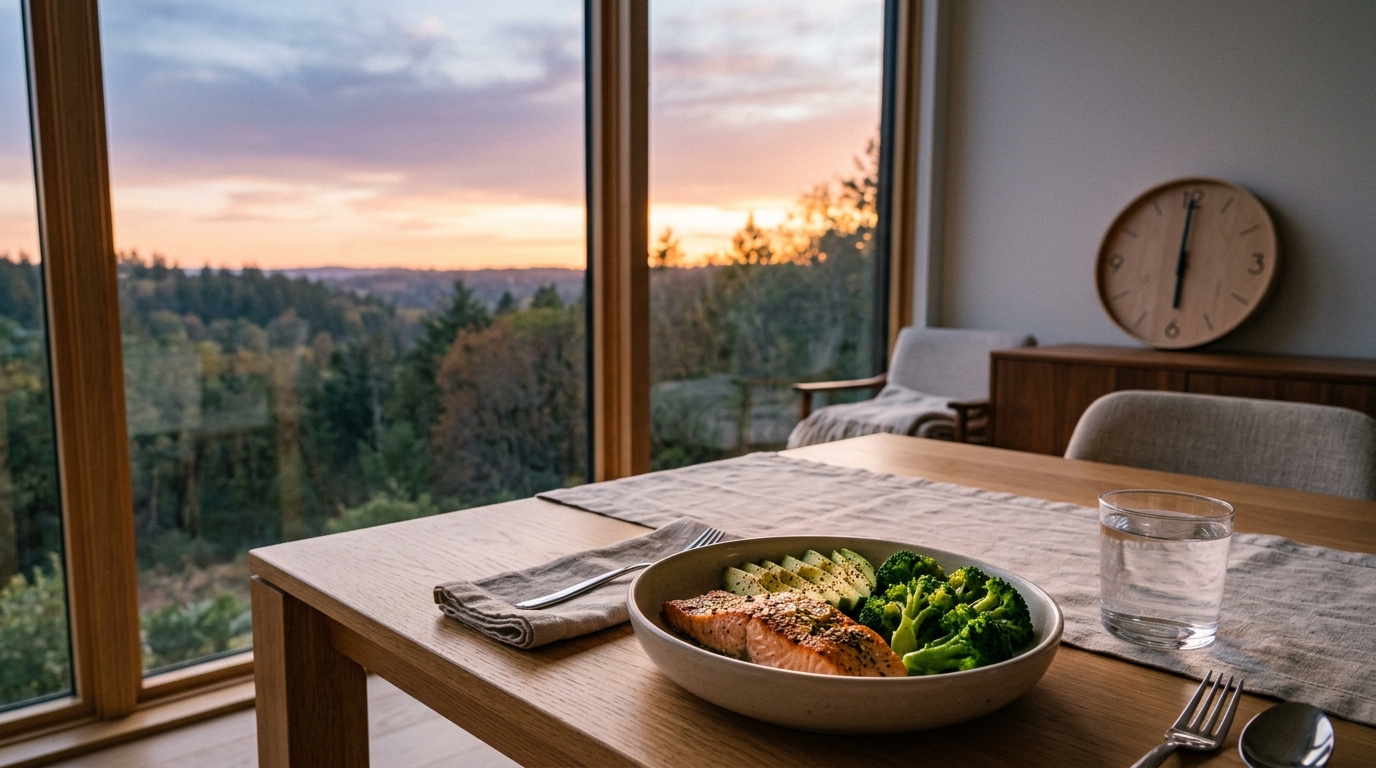
1. What is your biological clock?
Circadian rhythms are approximately daily patterns in functions such as sleep, hormone release, appetite and digestion. The brain’s central clock helps coordinate rhythms across organs and tissues, while environmental signals help keep those rhythms aligned.
The NIGMS explanation of circadian rhythms identifies light and darkness as major influences, with food intake, activity and other factors also contributing. This is a biological timing system, not simply a rule that digestion switches off after a particular hour.
That distinction matters when comparing people. Someone who sleeps early, someone whose bedtime is much later and someone rotating through night shifts may eat the same meal at the same clock time in quite different circumstances.
A useful question is therefore “where does this meal sit in my waking and sleeping day?” A second question is whether that pattern stays reasonably consistent or changes markedly between workdays and days off.
Neither question diagnoses a disorder. They help describe the situation more accurately than labelling every meal after an arbitrary evening cutoff as a metabolic failure.
2. Why can late eating change glucose and insulin responses?
Biological timing and misalignment can affect insulin secretion or tissue responsiveness. Because glucose tolerance depends on both, a higher post-meal glucose value does not automatically mean the body released more insulin.
In controlled laboratory experiments by Morris and colleagues, healthy adults had poorer glucose tolerance in the biological evening than morning. The researchers also found a separate adverse effect from experimentally misaligning the sleep, waking and eating cycle with the internal clock.
The mechanisms were not identical: the evening response involved reduced early insulin secretion, while misalignment appeared to reduce insulin sensitivity. Asking why eating late spikes insulin therefore assumes a response that is not universal.
These experiments isolated mechanisms under controlled conditions. They do not allow you to diagnose insulin resistance from the time you ate dinner or calculate your personal response from a group average.
Our insulin resistance explanation gives wider context. Use meal timing as one part of the picture rather than assuming every glucose change is a clock problem.
3. What happens when researchers move the same food later?
Moving dinner later can worsen glucose handling under controlled conditions, without proving that every late meal causes disease. A 2020 randomised crossover trial compared dinner at 6 p.m. with dinner at 10 p.m. in 20 healthy adults. Food intake was controlled, and the scheduled sleep period began at 11 p.m.
The late dinner produced higher post-meal glucose and lower oxidation of dietary fat during the observation period. The effects were more pronounced in people who habitually slept earlier, suggesting that the relationship to sleep timing mattered.
This was an acute laboratory experiment, not proof that one late meal creates obesity or that dinner at 6 p.m. guarantees weight loss. It showed a short-term metabolic response to a specific change in timing.
A separate 2022 controlled crossover experiment shifted eating later while controlling food, activity, sleep and light exposure. Later eating increased hunger, altered appetite-related hormones and reduced waking energy expenditure in adults with overweight or obesity.
The researchers also examined changes in fat-tissue signalling. Those findings offer possible explanations for how repeated late eating could influence energy balance, but they do not provide a fixed number of kilograms that changing dinner will remove.
Together, the studies make an earlier meal biologically plausible for some people. They also show why the practical question is more precise than “is food after dark bad?”: which food, how late relative to sleep, under what routine and over what period?
4. What does early time restricted feeding actually involve?
Moving dinner earlier and compressing all meals into a short window are not identical changes. Early time restricted feeding combines the clock position of meals with the length of the daily eating period.
In a 2018 controlled feeding study, eight men with prediabetes completed both a six-hour early eating schedule, with dinner before 3 p.m., and a twelve-hour comparison schedule. Each condition lasted five weeks, and food was provided to maintain weight.
Measured insulin sensitivity improved with the early schedule even without weight loss. This was a small proof-of-concept trial in men, so the result cannot be treated as a universal instruction for women, people taking diabetes medicines or everyone who wants an earlier dinner.
Notice the strength of the design: keeping food and weight relatively controlled helps isolate timing. Notice its practical limitation too: a tightly managed research schedule may not resemble a household where the shared evening meal is the main opportunity to eat together.
The research question and your personal meal plan are related, but they are not the same thing.
5. Do larger fasting trials show lasting benefits?
Larger trials show mixed outcomes, and an early advantage may not persist at longer follow-up. A 2025 trial involving 197 adults compared early, late and self-selected eight-hour eating windows with usual care over twelve weeks. All groups received usual dietary care based on Mediterranean-diet education.
None of the time-restricted schedules produced significantly greater reductions in MRI-measured visceral fat than usual care alone. This does not rule out every possible benefit, but it challenges the claim that choosing an early window automatically removes more fat around the organs.
A 2023 trial in 209 adults at increased diabetes risk tested a different intervention: early eating combined with substantial food restriction on three nonconsecutive days each week. It was compared with daily calorie restriction and standard care.
Post-meal glucose tolerance improved more with the combined intervention than with daily restriction at six months, but that difference was absent at eighteen months. Because both timing and food intake changed, its results cannot be attributed simply to an earlier dinner.
| Headline outcome | What it does not automatically establish |
|---|---|
| Better insulin sensitivity | Permanent reversal of diabetes |
| A lower glucose response after a meal | Superior long-term weight loss |
| A smaller waist measurement | An MRI-confirmed reduction in visceral fat |
| Benefit during a supported trial | The same benefit after support ends |
This is a useful way to read any new fasting headline. Identify what was measured before deciding whether it answers the health question you actually care about.
6. Are eating before sunset benefits established by research?
The studies above tested defined schedules, not a rule tied to the local sunset. Sunset also changes with season and location, so “before sunset” does not describe the same eating window throughout the year.
Compare two hypothetical routines: breakfast at 7 a.m. with dinner at 7 p.m., and breakfast at 11 a.m. with dinner at 7 p.m. Dinner ends at the same time, but one eating window spans twelve hours and the other eight.
Now imagine moving both meals earlier without changing the interval between them. That changes the clock position while leaving window length alone, illustrating why duration and timing should be described separately.
Night work adds another layer. In a 14-day simulated night-work experiment, keeping meals in the daytime prevented the impaired glucose tolerance seen when participants ate during the night.
This is promising experimental evidence, but a laboratory shift simulation does not solve every real worker’s meal access, safety or medication needs. It does not justify telling someone doing demanding overnight work simply to avoid food without an individual plan.
The practical aim is to assess the whole pattern, including sleep and available breaks. People working nights need workable support, not a daytime timetable copied onto a different life.
7. How can you make an earlier dinner practical?
First, separate the three decisions: when meals happen, how long the eating period lasts and what food is eaten. Changing all three simultaneously makes it difficult to know which part of the plan helped or created a problem.
For a hypothetical office worker eating at 10 p.m. because cooking starts after a long commute, an earlier dinner may require prepared ingredients or a ready meal portion. Simply announcing a 7 p.m. deadline does not remove the commute or prepare the food.
For another person, dinner already happens at a workable time but is followed by repeated snacks while watching television. That is a different pattern from a genuinely late main meal and calls for a different decision.
Write down the proposed meals, including drinks or snacks that contain energy, before deciding that the window is shorter. A dinner moved earlier with unchanged late-night eating has changed one meal’s timing, but not necessarily the end of food intake.
Keep the food comparison honest too. Replacing a substantial meal with a small snack because the deadline arrived is not a clean test of meal timing; it also changes the amount and composition of food.
Choose a change that preserves adequate meals and can be followed on ordinary days. If the new arrangement repeatedly produces an impractical rush, missed food or major conflict with work, revise the arrangement instead of interpreting the difficulty as weak willpower.
8. Who needs an assessment before shortening the eating window?
Not everyone is a suitable candidate for meal skipping. Mayo Clinic Health System’s fasting guidance advises against it during pregnancy or breastfeeding, under age eighteen and with a history of disordered eating.
People with diabetes or other medical conditions need their treating team’s assessment before fasting. Medicines designed around food intake or a particular schedule cannot safely be rearranged simply to match a popular window.
Describe the proposed change precisely: which meal moves, which meal disappears, how long the gap becomes and whether treatment timing would be affected. “I want to eat earlier” can mean a modest schedule change or a much more restrictive plan.
Do not stop medicine, alter a dose or ignore symptoms to keep a fasting streak intact. If the plan is unsuitable, you can still work on meal quality, practical dinner preparation and a more consistent routine without imposing a strict eating window.
Our sleep and health article offers related context for the wider day. Meal timing should serve your health, not become the only part of it you are allowed to consider.
Sun-Synchronized Nutrition in the JK Lifestyle
One of the core tenets taught by Dr. Jahangir Kabir across the JK Lifestyle and Health Revolution community is aligning your meals with the natural rhythm of the sun. In traditional cultures, dinner was always consumed before sunset—a biological wisdom that modern chronobiology now fully validates.
Eating large carbohydrate-heavy meals late at night forces your body to digest food when your metabolism wants to rest and regenerate. By shifting your eating window earlier—completing your final meal by 6:00 PM or 7:00 PM—you unlock uninterrupted nighttime cellular repair.
During the fasting hours after sunset and upon waking, support your body’s hydration with plain water or warm water seasoned with a pinch of Ultimate Organic Life Himalayan Pink Salt to maintain electrolyte balance without stimulating insulin.
Molecular Chronobiology: Peripheral Clocks and the Melatonin-Insulin Axis
Modern chronobiology reveals that human metabolic efficiency is strictly governed by an internal circadian timing system consisting of a central master pacemaker and peripheral tissue clocks:
- The Master Pacemaker (SCN): Located in the hypothalamus, the suprachiasmatic nucleus (SCN) synchronizes internal biological rhythms to the 24-hour solar light-dark cycle via intrinsically photosensitive retinal ganglion cells (ipRGCs).
- The Peripheral Organ Clocks: The liver, pancreas, gut, and skeletal muscle possess autonomous molecular clocks operated by transcriptional feedback loops of CLOCK and BMAL1 genes. These clocks genetically program digestive enzyme secretion, hepatic glycogen turnover, and insulin sensitivity to be highest during morning daylight hours and lowest after twilight.
- The Melatonin-Insulin Receptor Antagonism: As darkness approaches, the pineal gland secretes melatonin into systemic circulation. Pancreatic beta cells possess high concentrations of melatonin receptors (MTNR1B). When melatonin binds to these receptors in the evening, it actively closes calcium channels and suppresses insulin secretion. Consequently, consuming an identical carbohydrate meal at 9:00 PM produces an exaggerated glucose spike and prolonged hyperinsulinemia compared to consuming it at 12:00 PM.
The Sun-Synchronized Daily Eating Schedule
| Circadian Window | Recommended Time | Metabolic Event | JK Lifestyle Actionable Protocol |
|---|---|---|---|
| Solar Awakening & Hydration | 6:00 AM – 7:30 AM | Cortisol Awakening Response (CAR); resetting SCN | Step outdoors for 15–20 minutes of morning sunlight. Drink 500ml water with 1/4 tsp Ultimate Organic Life Himalayan Pink Salt and lemon. |
| Peak Metabolic Feeding (Lunch) | 11:30 AM – 1:00 PM | Maximum insulin sensitivity & digestive enzyme output | The main meal of the day: generous clean proteins (eggs, fish, beef) and green vegetables sautéed in Ultimate Organic Life Grass-Fed Ghee. |
| Sunset Early Dinner | 5:00 PM – 6:30 PM | Final food intake before melatonin surge | Light nourishing meal: steamed greens, avocado, bone broth or fish with Ultimate Organic Life Extra Virgin Olive Oil. Zero food after 6:30 PM. |
| Overnight Autophagy Window | 7:00 PM – 7:00 AM | Cellular recycling, liver fat clearance, deep slow-wave rest | Turn off blue light screens by 9:00 PM. Engage in evening prayer (Namaz and Dhikr) to activate parasympathetic tranquility; sleep before 10:30 PM. |
Frequently Asked Questions
Are eating before sunset benefits guaranteed?
No universal sunset cutoff was established by these trials. They tested particular meal schedules and outcomes rather than a changing astronomical deadline.
What is the best eating window for circadian rhythm fasting?
Research does not establish one best window for everyone. Timing, duration, adequate food, health conditions and treatment all affect whether a plan is appropriate.
Does evidence explain why eating late spikes insulin?
Not as a universal rule. Glucose tolerance can change through insulin secretion or tissue responsiveness; the studies do not show that every late meal produces an insulin spike.
What if I work night shifts?
Meal timing may matter, but experimental findings need adaptation to real working conditions. Discuss actual sleep, breaks, food access and treatment instead of copying an early-day schedule unchanged.
Should I adjust medicines to fit a fasting window?
No independent changes. Ask the prescribing team whether the proposed schedule is appropriate and whether any supervised treatment adjustment is needed.
The Bottom Line
Circadian rhythm fasting has a biological basis and meaningful research limits. An earlier dinner may be worth considering, but the useful plan is one that preserves nutrition, fits treatment and addresses your actual routine; a Health Revolution consultation can support that decision.
Book Your Lifestyle Consultation — Call 09678-242404.