
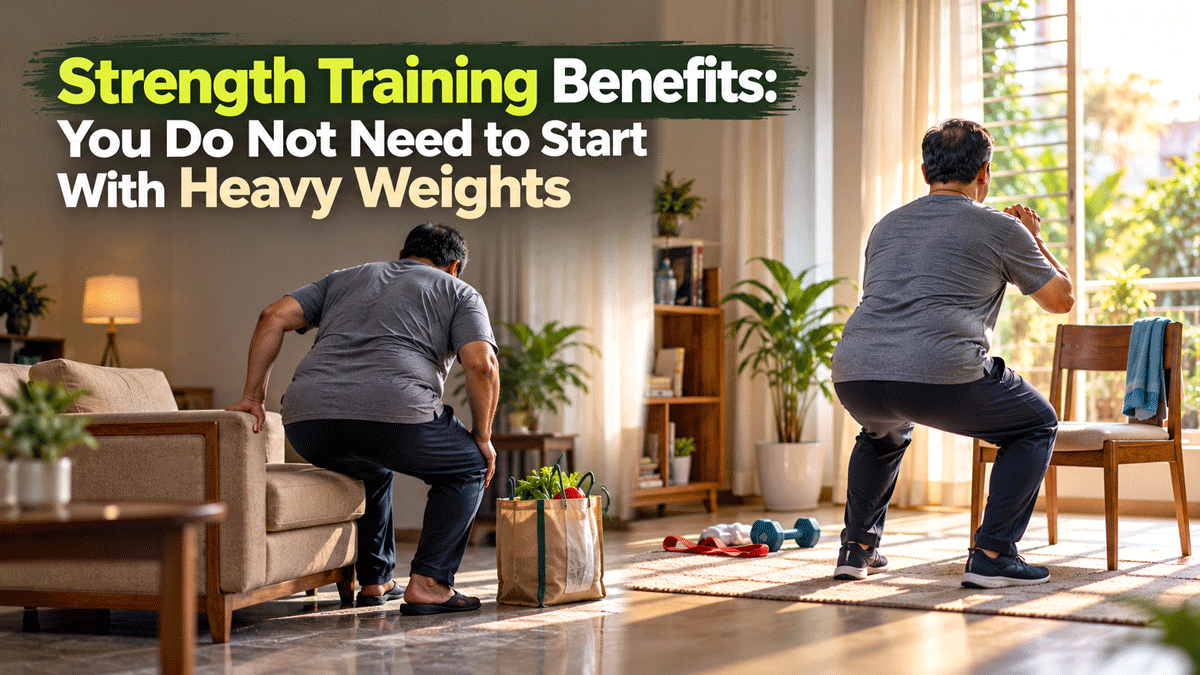
Strength training benefits include stronger muscles, easier everyday movement and support for long-term muscle health. Beginners can use suitable bodyweight exercises, bands or light weights, then progress as their control and capacity improve.
A shopping bag feels heavier halfway home. Getting out of a low chair takes a second attempt, and the gym looks like a room designed for people who are already strong.
What Are the Health Benefits of Strength Training for Beginners?
Strength training builds functional muscle mass, expands your body’s primary glucose disposal sink, increases bone mineral density, and elevates resting metabolic rate. Beginners do not need intimidating heavy gym equipment—starting with bodyweight movements (wall push-ups, chair squats) or light resistance bands delivers profound metabolic and insulin-sensitizing benefits.
- Metabolic Engine: Skeletal muscle clears roughly 80% of post-meal blood glucose; preserving muscle prevents type 2 diabetes.
- Sarcopenia Defense: Counteracts the natural 3% to 8% muscle loss per decade that occurs after age 30.
- Accessible Progression: Effective resistance training focuses on proper form, joint stability, and gradual consistency rather than extreme loads.

1. How do muscles and the nervous system become stronger?
Strength can improve through changes in muscle tissue and the nervous system that controls it. Resistance training challenges both systems by asking muscles to produce force against a load.
That helps explain why becoming stronger and looking more muscular are not identical experiences. Learning to control an unfamiliar movement can matter before a visible change in muscle size becomes obvious.
In a six-week study of lower-body resistance training, researchers followed 40 participants, including 22 in the training group. Changes in muscle contractile properties appeared early, followed by changes in strength and nervous-system excitability, with measurable muscle architecture changes later.
This was a small study using specific exercises and measurements, not a timetable for everybody’s results. Its useful message is that adaptation has several components, so a mirror alone cannot tell you whether training is working.
For example, imagine learning a seated exercise on a machine. Remembering the seat position, moving through the intended range and lowering the load without dropping it are concrete skills to establish before using a heavier setting.
Keep those details in your definition of progress. A heavier weight lifted with a different movement is not a clean comparison with the controlled repetition you performed last week.
2. How do strength training benefits support everyday independence?
Greater strength can make lifting, carrying and rising from a chair more manageable. These tasks may also require muscular endurance: the ability to keep repeating a movement rather than produce force just once.
The NHS guide to strength and flexibility describes benefits for everyday tasks and the preservation of muscle and bone as people age. This makes muscle health broader than a particular arm measurement or body shape.
Consider this hypothetical comparison: two people carry the same grocery bag, but it represents a much larger share of one person’s available strength. Improving that person’s capacity could make the task less demanding without changing the bag itself.
Longer-term research also gives reason to take muscle function seriously. In the Danish LISA resistance-training trial, 451 adults around retirement age were assigned to a year of heavy resistance training, moderate training or a control group.
At the four-year assessment, the heavy-training group had maintained baseline isometric leg strength. Participants were relatively healthy and functioning well, and the intervention was supervised; this does not mean every older beginner should immediately lift heavy weights alone.
It does show why preserving an ability can be a meaningful outcome. Success need not mean continually breaking a personal record, especially when maintaining independence is the central goal.
3. How can resistance exercise support metabolic health?
Resistance exercise can support glucose regulation, blood pressure and other cardiovascular risk factors. Those effects sit alongside its more visible effects on muscle strength and body composition.
The American Heart Association’s 2023 resistance-training statement describes benefits in people with and without cardiovascular disease. It also explains why combining resistance and aerobic exercise can offer advantages for several health measures.
This is a reason to include strength work in a wider plan, not a promise that a few sessions will normalise a laboratory result. Your starting health, the programme and other treatment all affect what happens.
A useful comparison is the difference between walking comfortably for a sustained period and completing a controlled set of wall press-ups. These activities create different demands, so doing one does not automatically provide every benefit of the other.
Avoid judging a session solely by sweat, breathlessness or the number of calories displayed on a watch. Those observations do not describe which muscles were trained, the resistance used or the quality of the movement.
If blood sugar is part of your concern, our insulin resistance explanation provides related context. Keep prescribed treatment in place while evaluating what an appropriate activity routine contributes.
4. How does strength work support bones and balance?
Bone is living tissue that responds to mechanical demands. Weight-bearing activity and the forces created by resistance exercise provide different ways of loading the skeleton, while stronger muscles can support movement and balance.
The NIAMS explanation of exercise for bone health distinguishes weight-bearing, muscle-strengthening and balance activity. Thinking about these separately prevents a common mistake: assuming one exercise completely addresses bone strength, fall risk and every other aspect of fitness.
For someone with osteoporosis, a previous fracture or significant movement limitations, exercise selection needs adaptation. An exercise that is suitable for one person may place an inappropriate load on another person’s spine or joints.
Picture two different goals: being able to rise from a chair and being able to remain steady while turning. Both matter, but a plan should identify which ability it is practising instead of calling every movement a general strengthening exercise.
This distinction is especially useful when choosing a class. Read what it actually teaches: resistance work, walking, balance practice or stretching, and then check whether that content matches the ability you want to improve.
5. Which resistance method should a beginner choose?
A muscle responds to the challenge placed on it, not the price or appearance of the equipment. Bodyweight, bands, free weights and machines can all be valid ways to create resistance.
The ACSM’s 2026 resistance-training guidance emphasises consistent participation and training major muscle groups. For most healthy adults seeking general benefits, complicated programmes and taking every set to complete muscular failure are not essential.
Specialised goals still require specific programming: maximising strength, building muscle size and developing power are related but different objectives. A beginner learning the movement does not need to copy the most demanding version of a trained athlete’s programme.
| Method | A useful question before choosing it |
|---|---|
| Bodyweight | Can I adjust the position to make this movement manageable? |
| Resistance band | Do I understand its setup, anchoring and condition? |
| Free weight | Can I pick it up, control it and put it down safely? |
| Machine | Do I know the seat settings and intended movement? |
Imagine a person choosing between an unfamiliar gym machine and a wall press-up demonstrated by an instructor. The simpler option may be the better learning choice today, even if a different exercise becomes useful later.
Equally, a machine may suit someone who needs its particular support and instruction. Choose on the basis of the person and task, not a rule that one type of equipment is always superior.
6. Which simple movements can you learn first?
The NHS home strength exercises include sit-to-stand, supported calf raises and wall press-ups. These are examples to learn, not a complete programme covering every major muscle group.
For chair exercises, use a solid chair without wheels that will not slide, with your feet able to rest flat. Rise slowly from sitting using your legs, then lower yourself with control rather than dropping onto the seat.
For a supported calf raise, hold the chair back and slowly lift and lower your heels. For a wall press-up, start facing the wall with hands around chest level, then bend and straighten your arms while keeping the movement controlled.
A repetition means completing one movement; a set is a group of repetitions. Five controlled chair rises followed by a rest is one set of five, not five separate sets.
The counting is useful only if the task remains comparable. If three repetitions use one chair and the next two use a much lower seat, write that difference down instead of treating the total as an identical exercise.
A hypothetical first-session note might read: “Five chair rises; controlled lowering; the final repetition needed arm support.” That description tells an instructor more than “legs done” and identifies what needs adapting before increasing the challenge.
7. How should you increase the challenge over time?
Increase the challenge gradually while preserving control, and allow recovery between sessions. General guidance recommends training the major muscle groups on at least two days a week. The AHA’s practical strength guidance describes increasing resistance, sets or training frequency as strength improves.
Those are different adjustments, not instructions to increase everything at once. An appropriate starting dose leaves you able to practise the intended movement and understand how your body responds.
Consider a hypothetical exercise record of eight controlled repetitions with a particular load. A later session of nine repetitions using the same load and technique represents a small, interpretable change; doubling the load and adding several sets would make the comparison much less useful.
There is no need to assign that progression to a fixed date. If control deteriorates, the relevant decision is to keep or reduce the challenge, not to chase an increase because a week has passed.
Check the whole session as well as an individual exercise. Adding an extra movement, additional sets and a harder variation all increase work, even if the weight printed on the dumbbell stays the same.
8. How do you protect technique and recognise warning signs?
Mayo Clinic’s technique guidance recommends controlled movement, appropriate loads and breathing throughout the exercise. Avoid holding your breath; typically, breathe out while lifting and in while lowering.
Allow recovery instead of training the same muscles hard on consecutive days. Stop an exercise that causes pain, and reduce the load or seek an appropriate assessment when pain or movement difficulty keeps returning.
Technique also matters before and after the counted repetitions. Picking up a weight awkwardly or dropping it back into place is still part of the task, even if your training log records only the middle section.
After a heart attack or stroke, follow the treating team’s exercise advice. Diabetes complications, cardiovascular disease and substantial mobility limitations may also require a programme adapted to the condition rather than a generic online routine.
Decide what help the problem requires: a fitness professional can teach an unfamiliar exercise, while persistent pain or unexplained weakness calls for clinical assessment. That distinction makes support practical and prevents treating every difficulty as a lack of effort.
Frequently Asked Questions
Do I need a gym to get strength training benefits?
No. Appropriate bodyweight movements, bands or simple weights can provide resistance at home; the important points are a suitable challenge, correct setup and a programme that eventually addresses the major muscle groups.
Will strength training automatically make me bulky?
Strength and visible muscle size are not the same measurement. Muscle growth depends on the training stimulus and other individual factors, and you can value improved control and everyday function without pursuing bodybuilding goals.
Can walking replace muscle-strengthening exercise?
Walking and strength work can complement each other. A walk does not automatically train all the major muscle groups against an appropriate resistance, so consider what each activity actually contributes.
Must I train until I cannot complete another repetition?
No. The ACSM guidance does not make complete muscular failure essential for the average healthy adult; learning the movement and using an appropriate challenge are better beginner priorities than forcing a failed repetition.
How do I know when to increase the weight?
Use the programme’s progression criteria and your ability to maintain the intended technique. More repetitions, extra sets and added weight are separate options; a qualified instructor can help choose the next change instead of increasing all three.
The JK Lifestyle Movement Pillar: Building Your Metabolic Armor
In the JK Lifestyle philosophy pioneered by Dr. Jahangir Kabir, muscle is recognized not merely as tissue for physical movement, but as an active endocrine organ that secretes beneficial anti-inflammatory myokines. Skeletal muscle is your body’s greatest protection against metabolic disease and insulin resistance.
We encourage patients of all ages to integrate gentle, progressive resistance training 2 to 3 times per week alongside their daily walking habit. Simple exercises performed at home—such as bodyweight squats, counter push-ups, and resistance band rows—stimulate muscle protein synthesis and pull stored glycogen out of muscles.
To support cellular repair and muscle protein maintenance, ensure your eating window includes adequate bioavailable protein (pasture-raised eggs, fish, organic meat) cooked in healthy fats like Ultimate Organic Life Grass-Fed Ghee, followed by a pinch of pink salt in water for essential cellular hydration.
The Muscle-as-an-Endocrine-Organ Revolution: Myokines and Glucose Disposal
Modern exercise endocrinology has proven that skeletal muscle is not merely mechanical tissue for locomotion—it is the human body’s largest, most powerful metabolic endocrine organ:
- The Primary Glucose Disposal Sink: Skeletal muscle is responsible for clearing approximately 80% of all postprandial glucose from systemic circulation. In an untrained or sarcopenic individual, the muscle glucose storage tank is tiny and congested with intramyocellular lipids (IMCL), forcing glucose to back up into the bloodstream. Resistance training stimulates glycogen depletion, creating an immense, hungry metabolic sink that pulls glucose out of the blood.
- The Myokine Secretome (IL-6 and Irisin): When skeletal muscles contract against resistance, they synthesize and secrete signaling peptides called myokines into the bloodstream:
- Muscle-derived Interleukin-6 (IL-6): Unlike pro-inflammatory macrophage-derived IL-6, exercise-induced myokine IL-6 acts in an anti-inflammatory cascade, directly stimulating hepatic fatty acid oxidation, increasing whole-body insulin sensitivity, and mobilizing visceral fat.
- Irisin: Cleaved from the FNDC5 membrane protein during resistance training, irisin travels to white adipose tissue and triggers “browning”—converting energy-storing white fat into thermogenic beige fat that burns calories as heat through uncoupling protein 1 (UCP-1).
The 3-Day Beginner Home Resistance Progression
Beginners do not need expensive gym memberships or heavy barbells to stimulate muscle protein synthesis and GLUT4 translocation. This evidence-based home routine focuses on high-threshold motor unit recruitment using bodyweight and light resistance:
| Movement Pattern | Beginner Home Exercise | Sets & Reps | Cadence / Tempo Guidance |
|---|---|---|---|
| Squat / Knee Flexion | Chair Squat (Sit back to chair, hover for 1 second, then drive up through heels). | 3 sets of 10–12 reps | 3 seconds lowering (eccentric), 1 second pause, 1 second rising (concentric). |
| Horizontal Push | Incline Countertop Push-Up (Hands on sturdy kitchen counter, body straight). | 3 sets of 8–10 reps | 2 seconds lowering, 1 second pause at chest, 1 second explosive push. |
| Horizontal Pull | Doorframe Row or Resistance Band Row (Squeeze shoulder blades tightly). | 3 sets of 12–15 reps | Hold peak contraction for 2 full seconds to engage the rhomboids and lats. |
| Posterior Chain / Hips | Floor Glute Bridge (Lying on back, drive hips upward and contract glutes). | 3 sets of 12–15 reps | Squeeze glutes hard at top for 2 seconds before descending slowly. |
The Bottom Line
Strength training benefits reach into the ordinary tasks you want to keep doing confidently. Start with a movement you can control, understand how progression works and build a programme around your abilities; a Health Revolution consultation can help place that work within your wider lifestyle plan.
Book Your Lifestyle Consultation — Call 09678-242404.